
Why Georgia's Red Clay Soil Matters for Your Concrete Project
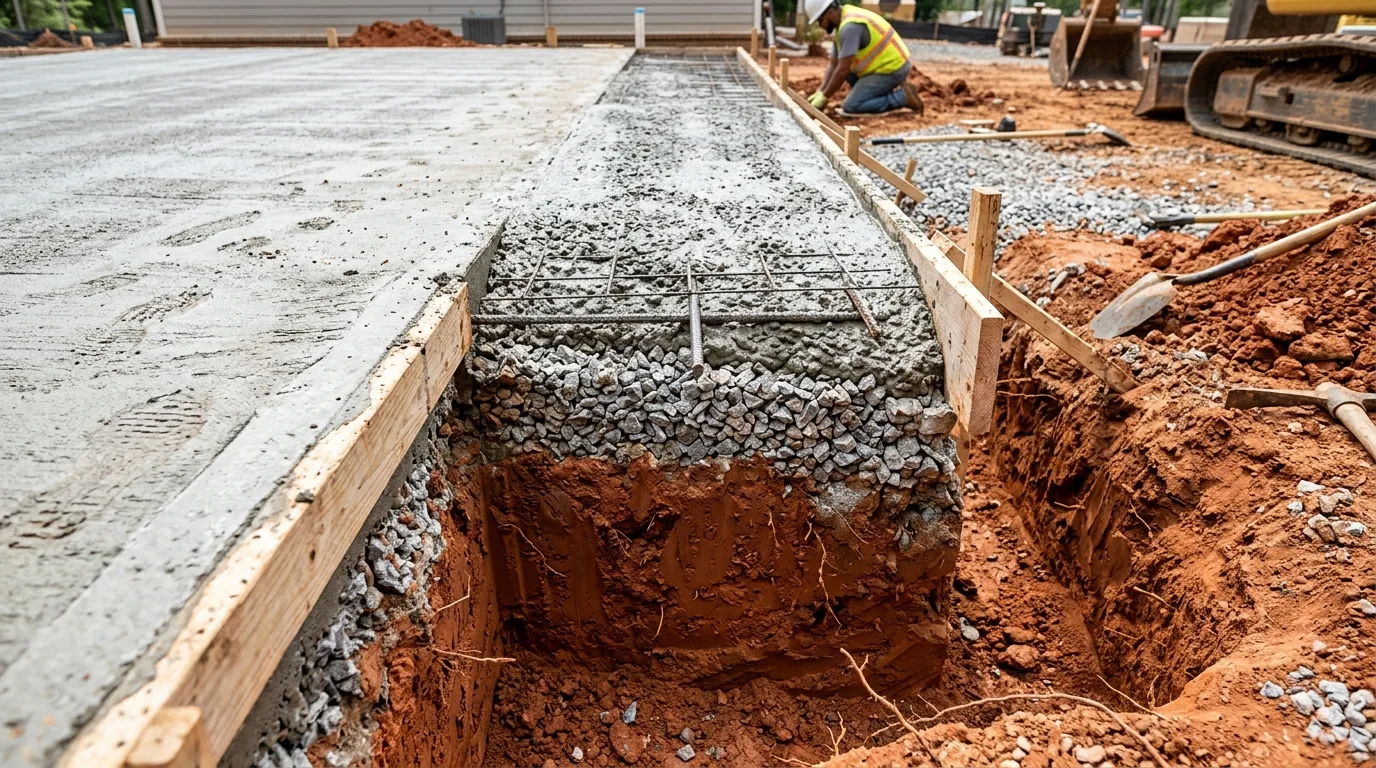
Ask any experienced concrete contractor in Suwanee about Georgia’s red clay soil and you’ll get an immediate, specific answer: it’s the single biggest factor that separates a concrete project done right from one that cracks within a few seasons. Gwinnett County’s Piedmont red clay expands when wet and contracts when dry, generating forces that can crack an undersized foundation slab or dislodge concrete walkway sections that were poured with inadequate base preparation. This post explains exactly why the soil behaves this way and what it means for concrete work at your Suwanee property.
In this post, we cover: what makes Gwinnett County’s clay different, how it damages concrete over time, the corrective measures that prevent damage, and which concrete projects are most affected.
Gwinnett County Clay Soil Expertise — Free Estimates
Every Suwanee Concrete Pros estimate accounts for local soil conditions. Call (888) 376-0955.
What Makes Gwinnett County’s Clay Soil Expansive
The Gwinnett soil series — officially classified as deep, well-drained, moderately permeable soils formed from intermingled basic crystalline materials — dominates the subsurface throughout Suwanee and the surrounding northern Gwinnett County area. The key characteristic is its clay mineral composition: smectite and illite clay minerals that have high surface area and strong water-absorbing capacity.
When rain falls on Suwanee — and the area gets 55 inches annually — these clay minerals absorb water molecules and swell. The swelling isn’t trivial: fully saturated Gwinnett County clay can increase in volume by 10–15% compared to its dry state. Conversely, during dry summer stretches and Suwanee’s mild winters, the same clay desiccates and shrinks, pulling away from structures and creating voids beneath concrete slabs.
This wet-dry cycle happens every year. Homeowners in neighborhoods like Riverbrooke and Old Town Suwanee experience it as a seasonal pattern: spring rains cause the ground to heave slightly, summer drying causes it to pull back, and the net effect over years is cumulative movement stress on any concrete placed over the clay.
How Clay Soil Damages Concrete Slabs in Suwanee
The damage pattern from Gwinnett County clay is distinctive and consistent. It typically starts at concrete edges and control joints — the locations where the clay’s lateral movement stress is least constrained. Edge cracking along driveway sides appears first, often within 3–7 years on driveways installed without adequate stone base depth. As cracks widen, water infiltrates them, the clay beneath the crack edge gets saturated and expands further, and the crack grows.
On patios and walkways, the clay movement shows as differential settlement: one section rises while the adjacent section drops, creating an uneven surface with trip hazards at joint lines. This is most common in the Brushy Creek and Suwanee Station neighborhoods where topsoil organic content is higher and the clay layer is closer to the surface. Homeowners often describe the problem as “the patio just shifted” after a wet spring, which is precisely what happened — the clay beneath it moved.
Foundation slabs on Gwinnett County clay without post-tension reinforcement show the third damage pattern: interior cracking in a diagonal pattern from corners, which is the signature of differential uplift from clay swelling on different sections of the slab at different moisture levels.
The Corrective Measures That Prevent Clay Damage
Understanding the damage mechanism makes the solution clear. You can’t prevent the clay from moving — but you can prevent that movement from reaching the concrete.
Stone base depth: Replacing the clay layer beneath concrete with 2–4 inches (or more for foundations) of compacted crushed stone breaks the direct contact between the expansive clay and the concrete. Crushed stone doesn’t expand with moisture — it simply drains. The stone base absorbs the clay’s movement before it transmits to the slab. This is the most important variable in any concrete project on Gwinnett County clay.
Vapor barriers: A 6-mil poly vapor barrier installed beneath slabs prevents moisture from migrating up through the stone base from the clay below. Moisture vapor movement is slower than direct clay contact, but over time it contributes to interior concrete deterioration on slabs poured without barrier protection.
Reinforcement: Steel rebar or post-tension cables give concrete slabs tensile strength to resist the bending forces created by non-uniform support from clay below. Fiber-reinforced concrete handles minor movement but is not a substitute for rebar or post-tension on active clay sites. For foundations, post-tension slab design is increasingly recommended by structural engineers throughout Gwinnett County.
Drainage design: Managing water away from concrete is as important as the base and reinforcement. Concrete that sits in drainage low spots keeps the surrounding clay perpetually saturated, maximizing swelling and movement. Every concrete project in Suwanee should include a drainage assessment that confirms water moves away from all concrete edges.
Proper Clay Soil Prep for Every Suwanee Concrete Project
We engineer every project for Gwinnett County's soil conditions. Free estimate — (888) 376-0955.
Which Projects Are Most Affected by Clay Soil in Suwanee
Driveways: High impact. The large surface area of a driveway spans different soil moisture zones, especially on sloped lots. Edge cracking and mid-slab cracking are common without adequate stone base. A driveway replacement in Suwanee that doesn’t include a soil assessment and appropriate base depth specification is likely to repeat the failure of the original installation.
Patios and walkways: High impact. Narrow elements like walkways are especially vulnerable to lateral clay movement because they have less mass to resist edge displacement. Tree root proximity compounds the risk by creating localized soil desiccation zones where roots extract moisture.
Foundations: Critical impact. Foundation design in Suwanee must account for Gwinnett County clay as a primary variable. Post-tension slabs and appropriate stone base depth are not optional on sites with documented clay activity — they’re engineering necessities. See our concrete foundation page for the full foundation approach for Suwanee properties.
Concrete repair: The clay context matters here too. A crack fill that doesn’t address the underlying drainage or base issue will re-open. A mudjacking job that lifts a settled section without improving drainage may re-settle within a few years. Understanding the clay mechanism is the first step in diagnosing whether a repair will last.
Frequently Asked Questions
Is Georgia’s red clay soil worse than other regions for concrete?
It depends on the comparison. Gwinnett County’s clay is more expansive than sandy coastal soils, which is why proper base preparation is more critical here than in, say, Savannah’s sandy coastal market. It’s similar to expansive clay conditions in parts of Texas and the Carolinas. The conditions are well-understood and manageable — they just require specific engineering choices that experienced Suwanee concrete contractors routinely apply.
How do I know if my property has significant clay issues?
Most Suwanee properties have Gwinnett series clay — it’s the dominant soil type throughout northern Gwinnett County. Visible signs of active clay on your property include existing concrete cracks along edges and joints, doors or windows that stick seasonally (a sign of foundation movement), and areas where the ground visibly cracks during dry summers. A concrete contractor’s site assessment will evaluate the visible evidence and recommend appropriate base preparation.
Does clay soil affect when I should pour concrete?
Yes — wet clay is harder to compact properly for base preparation. Most contractors prefer to prepare subgrades when soil moisture is moderate rather than saturated. This is another reason spring and fall are optimal concrete seasons in Suwanee: soil moisture conditions during those seasons are more favorable for stable compaction.
Clay-Soil-Aware Concrete Work in Suwanee
Suwanee Concrete Pros accounts for Gwinnett County soil conditions on every project. Free estimates throughout Gwinnett County — (888) 376-0955.
Related: