
How Long Does Concrete Take to Cure in Georgia Weather?
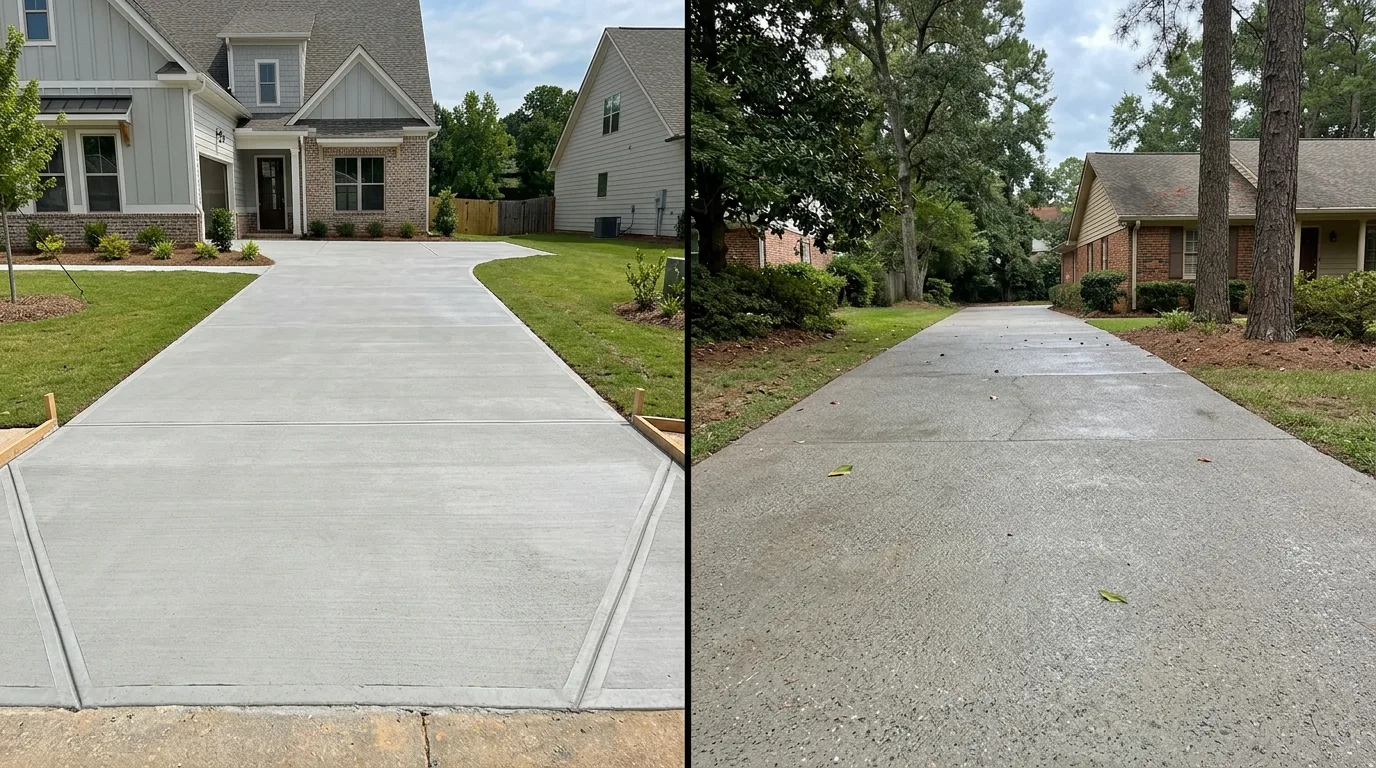
“How long before I can drive on it?” is the question every Suwanee homeowner asks after a new driveway or patio is poured. The short answer: 24–48 hours for foot traffic, 7 days for light vehicles, 28 days for full load. But Georgia’s specific climate — and Suwanee’s particular combination of heat, humidity, and clay soil — affects what happens during those 28 days in ways that matter for the quality of the final result. This post explains the curing process, the Georgia-specific factors that affect it, and what homeowners can do (and avoid) during curing to protect their new concrete.
In this post, we cover: the concrete curing timeline, how Georgia’s heat and humidity affect curing, the difference between dry and cured, what to avoid during curing, and how the Gwinnett County clay subgrade affects the process.
Questions About Your New Concrete in Suwanee?
We walk every homeowner through what to expect during curing. Free estimates for new projects — (888) 376-0955.
The Concrete Curing Timeline
Concrete “cures” rather than “dries.” The chemical reaction — hydration — involves water molecules bonding with cement particles to form calcium silicate hydrate crystals, which give concrete its strength. This reaction doesn’t stop at a specific point; it continues for years, though the practical strength development milestones are:
24 hours: Concrete is firm enough for foot traffic. Early pedestrian loading is low-risk. Avoid concentrated point loads (furniture legs, tool drops) and any vehicle traffic.
3 days: Approximately 40% of final design strength. Concrete feels solid but is still gaining strength rapidly. Avoid all vehicle traffic.
7 days: Approximately 70% of final design strength. Light passenger vehicles (under 4,000 lbs) can be driven on the surface. Avoid heavy trucks, SUVs with trailers, and heavy equipment.
28 days: Approximately 99% of design strength. Full vehicle loads are appropriate. The slab can be considered fully loaded from this point forward.
Ongoing: Concrete continues to gain small amounts of additional strength for years. A 1-year-old slab is marginally stronger than a 28-day-old slab, though the practical difference for residential applications is negligible.
How Georgia’s Summer Heat Affects Curing in Suwanee
Georgia’s summer climate — Suwanee’s July highs average 89°F — creates the risk of rapid moisture evaporation from concrete surfaces during the critical early curing period. If the surface loses moisture too fast, the hydration reaction in the surface layer is disrupted before full crystalline structure forms, resulting in:
- Surface cracking (plastic shrinkage cracks): Fine cracks that form as the surface dries faster than the interior, creating differential shrinkage. These appear within the first few hours of pouring on hot, windy summer days.
- Surface dusting: The surface becomes weak and powdery because the cement paste in the surface layer was desiccated before hydration completed.
- Lower surface strength: The surface layer achieves less than its designed compressive strength.
The mitigations our crews use for summer pours in Suwanee include: early morning pour scheduling (starting at 6–7 AM to take advantage of cooler morning temperatures), evaporation retarder applied immediately after finishing, wet burlap curing blankets for the first 24–72 hours, and — for large pours — working in sections to reduce the finishing window.
How Suwanee’s Winter Cold Affects Curing
The hydration reaction slows dramatically as concrete temperature drops below 50°F and essentially stops at or below 40°F. Fresh concrete that freezes before gaining sufficient strength is permanently damaged — the expanding ice crystals disrupt the crystalline structure that was forming, creating internal microfractures that compromise the slab for its entire lifespan.
Suwanee’s winters are mild — the area averages only 6–10 days per year below 32°F, most of them in December, January, and February. But those nights matter. For concrete poured on days when the overnight low is expected to approach 40°F, insulating curing blankets that trap the heat from the hydration reaction keep the concrete above the critical temperature until it gains sufficient strength to resist freeze damage (typically after 24–48 hours of protected curing in mild winter conditions).
All-Season Concrete Installation in Suwanee
We manage curing for every season — hot Georgia summers and cold Georgia nights. Free estimates — (888) 376-0955.
The Difference Between “Dry” and “Cured” for Georgia Homeowners
The most common misconception about concrete curing: concrete that looks and feels dry is fully cured. It isn’t. Concrete can appear dry on the surface — because the surface layer has indeed lost most of its free water — while the interior is still actively hydrating and the full reaction continues for weeks.
This misconception is most consequential for sealers. Many homeowners or contractors apply sealer too early because the concrete “looks dry.” Sealer applied to incompletely cured concrete traps residual moisture inside the slab, which can cause whitening, delamination, or bubbling. The minimum cure time before sealing varies by product but is typically 28–30 days for most acrylic sealers, and longer for penetrating sealers on freshly poured slabs.
In Suwanee’s climate, we recommend waiting at least 28 days after the pour before sealing, and testing surface moisture with a plastic sheet test before applying any coating or sealer. Place a 2×2 foot plastic sheet on the concrete and tape the edges down. If moisture condenses on the underside after 24 hours, the concrete still contains enough vapor transmission to affect sealer bonding.
How Gwinnett County’s Clay Soil Affects the Curing Environment
The clay soil beneath Suwanee concrete slabs affects the curing process in a way many homeowners don’t realize: moisture vapor from the clay migrates upward through the stone base and the fresh concrete. During the first 28 days, this vapor transmission from below adds moisture to the curing process — which can actually be beneficial in very hot, dry conditions (it slows evaporation from below). In humid Georgia summer conditions, the added moisture from clay vapor transmission is less significant, but it remains a reason to install vapor barriers beneath slabs intended for coatings or polished finishes.
Properties throughout Riverbrooke and the Suwanee Creek Greenway corridor often have higher clay moisture content due to the area’s proximity to wetlands. Post-pour moisture monitoring is more relevant on these sites than on well-drained upland properties.
Types and Options for Managing the Curing Period
Wet curing (misting or wet blankets): Maintaining the concrete in a moist state by applying water or wet curing blankets during the first 7–14 days. The most effective curing method for maximizing strength development. In Suwanee’s summer, wet curing is essential for large pours — the moisture it provides offsets evaporation losses and keeps the hydration reaction proceeding optimally.
Curing compounds: Liquid compounds sprayed on the concrete surface immediately after finishing create a membrane that retains moisture. Effective and efficient for standard residential work in Suwanee. They eliminate the labor of wet curing while providing acceptable moisture retention for most applications.
Cure-and-seal products: Combine the moisture retention of a curing compound with a light sealing function in a single application. Used on residential flatwork in Suwanee when the concrete specification allows it. Not appropriate for concrete that will later receive an epoxy coating, as the sealer residue interferes with coating adhesion.
Frequently Asked Questions
How long should I wait to drive on new concrete in Suwanee?
Wait 7 days for light passenger vehicles and 28 days for full vehicle loads including heavy trucks, vans, and equipment. In Georgia’s summer, this timeline assumes proper curing protection was applied — concrete poured without curing measures in July heat may need additional monitoring before full loading.
Can I seal my new Suwanee concrete driveway before 28 days?
No — most sealers should not be applied to new concrete before 28–30 days of curing. Applying sealer too early traps moisture that can cause the sealer to cloud, bubble, or delaminate. Wait the full cure period and confirm low surface moisture before sealing. See our concrete driveway maintenance guide for the full sealing process.
What happens if it rains on my new concrete in Suwanee?
Light rain in the first 24–48 hours after pouring can actually benefit curing by keeping the surface moist — provided the rain isn’t heavy enough to erode the fresh surface or disturb the finishing. Heavy rain immediately after finishing can damage surface texture. After the first 24 hours, rain is generally beneficial or neutral for concrete curing in Georgia.
Expert Concrete Installation and Curing in Suwanee
We manage every phase of the pour and curing period for Suwanee homeowners. Free estimates — (888) 376-0955.
Related: