
5 Signs Your Suwanee Driveway Needs Replacement, Not Repair
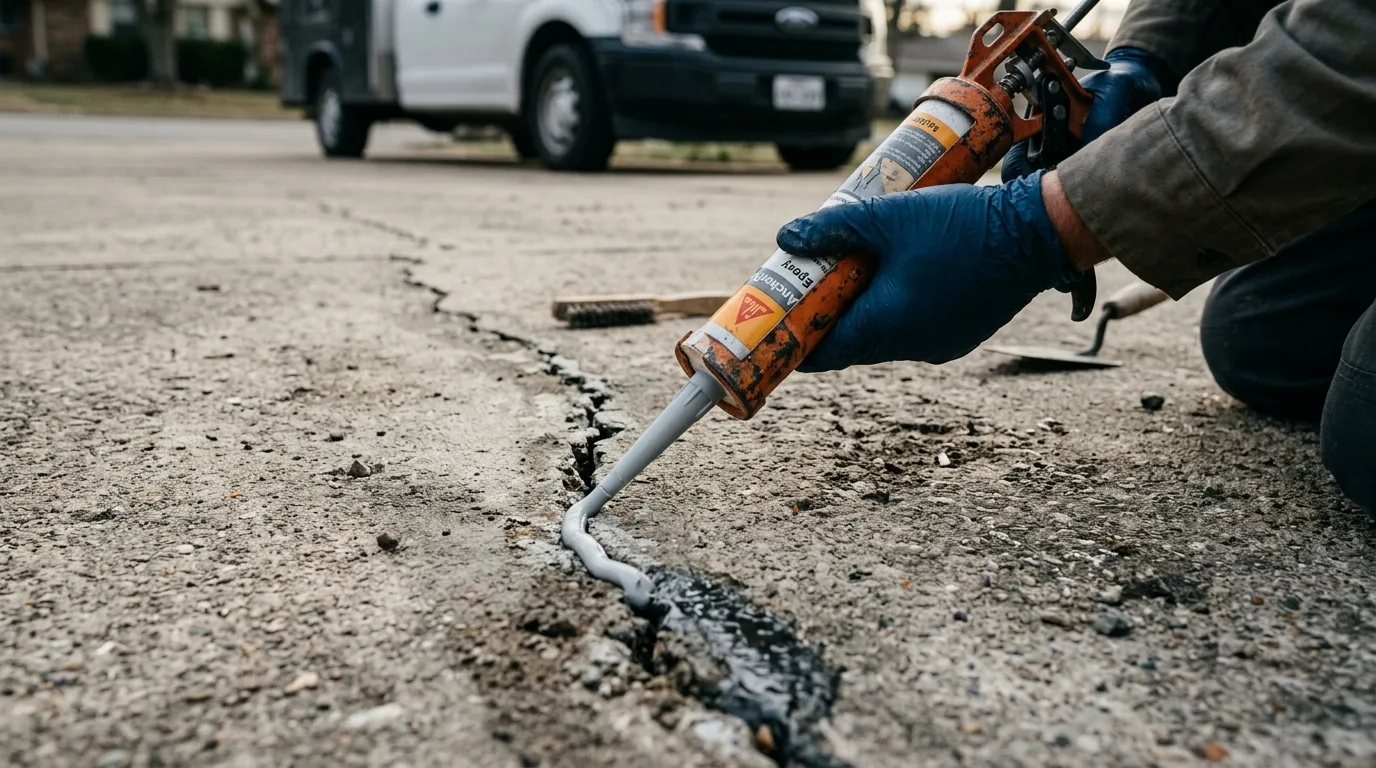
Every cracked driveway presents the same question: is this worth repairing, or is it time to start over? In Suwanee, where Gwinnett County’s expansive red clay soil is the primary driver of driveway deterioration, the answer often hinges on whether the damage is cosmetic or structural — and whether the root cause can be corrected without a full replacement. Here are five signs that tell you a Suwanee driveway has crossed the line from repairable to ready for replacement.
In this post, we cover: the five replacement indicators, how Gwinnett County clay influences the decision, when repair makes financial sense, and the typical cost comparison for Suwanee homeowners.
Not Sure If Your Suwanee Driveway Needs Repair or Replacement?
We give honest assessments — free of charge. Call (888) 376-0955.
Why Replacement vs. Repair Matters for Suwanee Homeowners
The cost difference between repairing a driveway and replacing it is significant. Crack filling runs $200–$600. Mudjacking (slab leveling) averages $4.66 per square foot in Georgia. Full concrete driveway replacement runs $8–$20 per square foot — typically $4,800–$12,000 for a standard residential driveway in Suwanee.
Making the right call requires understanding what caused the damage. Suwanee’s clay soil creates a specific failure pattern: edges crack first, then settlement begins in sections where the clay has dried and contracted beneath the slab. A repair that fills the crack without addressing the drainage or base issue will fail again within 2–3 seasons. That cycle of repeated repairs can cost more over five years than a single correctly-executed replacement.
Sign 1: Cracking Is Widespread Throughout the Slab
One or two cracks — even substantial ones — may be repairable, especially if they’re limited to specific sections. But when cracking forms a network pattern across most of the driveway surface, the slab has failed structurally. This “map cracking” or “alligator cracking” indicates the concrete has lost its structural integrity throughout, not just at isolated stress points.
In Suwanee homes with clay soil movement and older driveways poured without adequate stone bases, this pattern often develops by the 15–20 year mark. Once a driveway reaches this stage, no amount of crack filling will restore the surface to functional condition — you’re simply filling cracks that will continue to expand and multiply as the underlying clay cycles seasonally.
Sign 2: Sections Have Settled More Than One Inch
Concrete driveway sections typically settle when voids develop beneath them — usually from clay shrinkage pulling away from the slab base, or from drainage water eroding fine material out of the subgrade. Minor settlement (less than ½ inch) is often correctible with mudjacking. Settlement exceeding 1 inch indicates the sub-base has significant voids or has completely failed in that section.
Properties near the Riverbrooke subdivision and along Suwanee Creek often have sections where clay settlement has created dramatic uneven surfaces — sometimes 2–3 inches of differential elevation between adjacent slabs. At this degree of settlement, mudjacking may not fully level the section, and the voids beneath the slab are often too extensive for grout injection to fill reliably. A section-by-section replacement assessment is needed.
Sign 3: The Concrete Is Spalling Across a Large Area
Spalling — the flaking or scaling of the top concrete layer — happens when the surface layer separates from the underlying concrete. Minor surface pitting is normal wear; spalling that exposes coarse aggregate across 25% or more of the driveway surface indicates deterioration that resurfacing alone won’t permanently resolve.
The distinction matters: resurfacing overlays bond to structurally sound concrete. When the underlying concrete is itself deteriorating — from freeze-thaw damage, long-term clay movement, or improper curing during the original pour — the resurfacing overlay has a compromised bond surface and is likely to delaminate within a few years. A professional assessment can determine whether the underlying concrete is sound enough to support a resurfacing overlay.
Sign 4: Drainage Problems Persist After Multiple Repairs
A driveway that consistently creates puddles near the home foundation, channels water along its edges toward the house, or floods in the center despite previous drainage work has a drainage design problem that patch repairs can’t fix. In Suwanee, drainage failures often originate from original installation errors — inadequate slope, missing drainage channels, or subgrade grading that directs water toward rather than away from the structure.
Correcting a fundamental drainage design problem requires regrading the subgrade and reforming the concrete’s slope — which is essentially a replacement with improved drainage design built in. Trying to repair surface symptoms without addressing the slope problem leads to continued water damage to the home’s foundation and continued concrete deterioration from saturated clay beneath the slab.
Sign 5: The Driveway Is 25+ Years Old With Accumulated Damage
Concrete driveways in Suwanee’s climate typically show the first significant deterioration after 15–20 years without maintenance. After 25+ years, especially on driveways poured without modern reinforcement specifications or adequate stone base depth, the accumulated damage from Gwinnett County clay cycles and Georgia’s seasonal extremes often makes repair impractical. The economics shift: spending $1,500 repairing an 28-year-old driveway that will need replacement within 3–5 years anyway rarely makes financial sense compared to investing in a new driveway that will last another 30+ years.
Free Driveway Assessment in Suwanee
We'll tell you honestly whether repair or replacement makes more sense for your specific driveway. No upselling — just facts. (888) 376-0955.
When Repair Still Makes Sense in Suwanee
Repair is the right choice when: the damage is limited to 1–2 specific sections rather than widespread; the underlying slab is structurally sound (no widespread cracking, no excessive settlement); drainage functions correctly; and the driveway is fewer than 20 years old. In these cases, crack filling, mudjacking, or localized section replacement addresses the problem without the cost of a full replacement.
The key is an honest assessment from a contractor who isn’t incentivized to recommend replacement when repair will genuinely solve the problem. We assess every Suwanee driveway with the goal of recommending the approach that provides the best long-term value — not the largest project.
Frequently Asked Questions
How do I tell if my driveway settlement can be fixed with mudjacking?
Mudjacking works best when: the settled section is mostly intact (not widely cracked), the settlement is less than 2 inches, and there’s a clear void beneath the slab that grout can fill. An experienced contractor can probe beneath the slab edges to assess void depth. Sections that have settled due to complete sub-base failure (not just a void) are better candidates for replacement.
Does Suwanee’s clay soil make driveway replacement last longer the second time?
Yes — if the replacement is done correctly. The key difference between a driveway that fails in 15 years and one that lasts 35 years in Suwanee’s clay soil is the depth and quality of the stone base beneath the concrete. A replacement project done with proper soil removal and base preparation addresses the root cause that failed the original driveway. Read our concrete driveway cost guide for what to look for in a replacement estimate.
Can I repair a stamped concrete driveway in Suwanee?
Stamped concrete repairs are more visible than plain concrete repairs because pattern and color matching is difficult. Minor crack fills in stamped concrete are feasible and often practical. Replacing a damaged section of stamped concrete driveway with matching pattern and color is technically possible but rarely achieves an invisible match. For widespread damage on stamped driveways, full replacement with a new stamped design is often the more aesthetically satisfying choice.
Honest Driveway Assessments in Suwanee
Suwanee Concrete Pros gives you the truth about what your driveway needs. Free assessment — (888) 376-0955.
Related: