
Concrete Pool Decks in Suwanee GA: What Homeowners Should Know
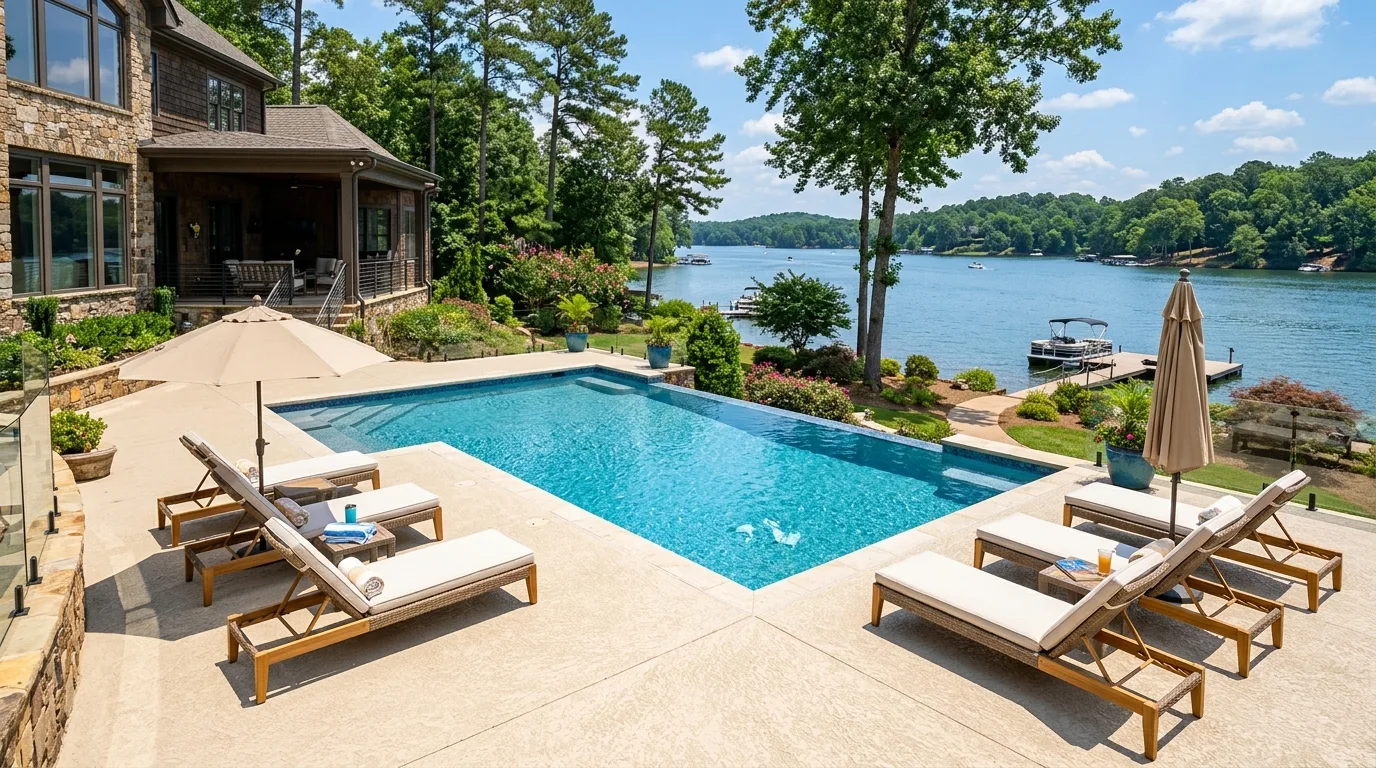
A concrete pool deck is one of the highest-impact hardscape investments a Suwanee homeowner can make — it surrounds the most-used outdoor feature on the property, and its appearance and condition define how the entire backyard looks and functions. What many homeowners don’t know until they start planning: pool deck concrete has specific requirements that differ from driveways and patios, and Suwanee’s particular combination of Georgia heat, clay soil, and pool chemical exposure creates additional considerations that affect material choice and design.
In this post, we cover: concrete vs. other pool deck materials in Suwanee, finish options for slip resistance and heat comfort, cost ranges, the effect of Georgia’s climate on pool deck concrete, and maintenance requirements.
Concrete Pool Deck Estimate in Suwanee — Free
We design pool decks for Gwinnett County's clay soil and Georgia's climate. Call (888) 376-0955.
Why Pool Deck Concrete Is Different From Other Concrete in Suwanee
Pool decks face conditions that no other concrete surface on a Suwanee property encounters simultaneously. The chemical exposure from pool water — chlorine and related compounds — can affect unsealed concrete over time, especially at the water’s edge. The continuous wet-dry cycling from splashing and rain keeps the surface perpetually damp in places, which affects both the concrete surface and the clay subgrade beneath it.
Most importantly: pool decks are where people walk barefoot in Georgia’s summer heat. A standard dark concrete surface in direct Suwanee summer sun can reach 130–140°F surface temperature — hot enough to cause burns within seconds. Pool deck design must account for both slip resistance (wet surface safety) and thermal comfort (temperature in barefoot conditions). These requirements point toward specific finish choices that many homeowners aren’t aware of until the conversation with a contractor.
Gwinnett County’s clay soil creates the same movement risks for pool decks as for patios, with the additional complication that pool water contributes to keeping the surrounding clay perpetually saturated — maximizing clay expansion and the risk of concrete movement at the pool’s edge sections.
Concrete Pool Deck Finish Options for Suwanee
Broom finish: The most common and cost-effective. The transverse broom lines provide slip resistance when wet. In Suwanee, a light-colored broom finish is the default specification for pool decks — the light color reflects heat, keeping surface temperatures in the 80–95°F range rather than the 130°F range of dark surfaces. This is the baseline for functionality and value.
Exposed aggregate: Popular in Suwanee’s Laurel Springs community and other neighborhoods where outdoor aesthetics matter. The exposed stone aggregate creates a textured surface with good slip resistance and — depending on the aggregate color — good heat reflectivity. Rounded aggregate is preferred over angular for barefoot comfort. Slightly more expensive than broom finish but provides significantly better aesthetics.
Stamped concrete pool deck: Seamless texture patterns (rather than defined-joint patterns) work best for pool decks, as they avoid the potential trip hazard of raised pattern edges near water. Slate and stone textures with light-colored base concrete are popular for pool decks in Suwanee’s upscale neighborhoods. The sealer must be a slip-resistant formula (look for anti-slip additives in the sealer spec) — standard decorative sealers can be dangerously slippery when wet.
Kool Deck / cool deck overlay: A spray-applied overlay specifically designed for pool decks that reflects UV radiation and stays significantly cooler than standard concrete. Widely used in hotter climate markets. Available in various colors and textures. Not stamped or heavily decorative, but excellent functional performance for Georgia’s summers.
Cost Ranges for Concrete Pool Decks in Suwanee
Pool deck concrete costs more per square foot than regular patios because of the additional design requirements, the precision needed at the pool coping interface, and the anti-slip sealer specification. Typical ranges in Suwanee and Gwinnett County:
- Broom finish pool deck: $6–$10 per square foot
- Exposed aggregate: $8–$12 per square foot
- Stamped concrete pool deck: $10–$14 per square foot
- Cool deck overlay on existing concrete: $3–$6 per square foot
Most residential pool deck projects in Suwanee involve 400–800 square feet of surface area (a standard pool plus surrounding deck), putting typical project costs in the $2,400–$11,200 range depending on finish selection and site conditions.
Design Your Suwanee Pool Deck — Free Consultation
We'll discuss finish options, slip resistance specs, and pricing for your specific pool layout. Call (888) 376-0955.
How Georgia’s Climate Affects Pool Deck Performance in Suwanee
Suwanee’s summer heat is the primary functional driver for pool deck material choice. Surface temperatures on dark or medium-tone concrete in Suwanee’s July sun regularly exceed 120°F — uncomfortable and potentially dangerous for barefoot use. Light-colored concrete (buff, white, light gray) with a matte sealer finish reduces surface temperature by 30–40°F compared to dark surfaces, making a meaningful difference for daily use.
The heavy rainfall Suwanee receives — 55 inches annually — keeps pool deck surfaces wet frequently, which has two effects. First, it tests the slip resistance of the surface continuously — surfaces that look slip-resistant when dry can become dangerously slippery when wet if the sealer formula doesn’t include anti-slip agents. Second, pooling water at the pool deck edges keeps the surrounding clay soil saturated, contributing to the edge movement that causes expansion joint cracking. Proper drainage design — including deck slope away from the pool’s structural shell and toward drainage areas — is essential for both safety and longevity.
Homeowners near the Suwanee Creek Greenway and in the Brushy Creek neighborhood often have properties with higher clay content near the surface, making drainage design an especially important conversation during the pool deck planning process.
Practical Uses of Concrete for Suwanee Pool Decks
Surrounding an inground pool: The standard application — concrete surrounds the pool on three or four sides, meeting the pool coping at the waterline. Expansion joints between the deck and coping allow for independent movement. The concrete deck can extend to adjacent outdoor living areas, creating a continuous surface from pool to patio.
Connecting pool to outdoor kitchen or patio: Stamped concrete or exposed aggregate pool deck that flows into a decorative patio area creates a cohesive outdoor living space. Pattern and color continuity between the pool deck and the patio area reinforces the design.
Resurfacing an existing pool deck: If the existing concrete is structurally sound but the surface has deteriorated (spalling, fading, staining), a cool deck overlay or thin bonded resurfacing overlay refreshes the appearance without the cost of full replacement.
Adding a splash zone: A shallow concrete splash pad adjacent to the pool — popular in Suwanee homes with young children — is poured as an integral part of the pool deck project with specialized drainage and a rubberized anti-slip surface.
Frequently Asked Questions
Do I need a permit for a concrete pool deck in Suwanee?
Pool deck work associated with a permitted pool installation is typically reviewed as part of that permit. Standalone pool deck resurfacing or patio additions adjacent to an existing pool may be permit-exempt under Gwinnett County’s residential concrete guidelines. We assess permit requirements for every project at the estimate stage.
How long does a concrete pool deck last in Georgia?
A properly installed concrete pool deck in Georgia lasts 20–35 years. Regular resealing (every 3–5 years with an anti-slip UV-resistant sealer) is the most important maintenance step. Expansion joint maintenance — keeping joints clean and filled with appropriate flexible sealant — prevents water infiltration into the clay soil beneath the deck edges.
What’s the best pool deck surface for Suwanee’s summer heat?
Light-colored concrete (buff, cream, light gray) with a matte finish provides the best combination of heat reflectivity and slip resistance for Suwanee’s summers. Cool deck overlays provide the best thermal performance of any concrete-based option. Exposed aggregate in light-colored aggregate is a popular middle ground — better appearance than plain concrete with good thermal and slip performance.
Concrete Pool Decks Built for Suwanee's Climate
Heat-reflective, slip-resistant, and designed for Gwinnett County clay soil. Free estimates — (888) 376-0955.
Related: