
Concrete Garage Floor Options for Suwanee Homeowners
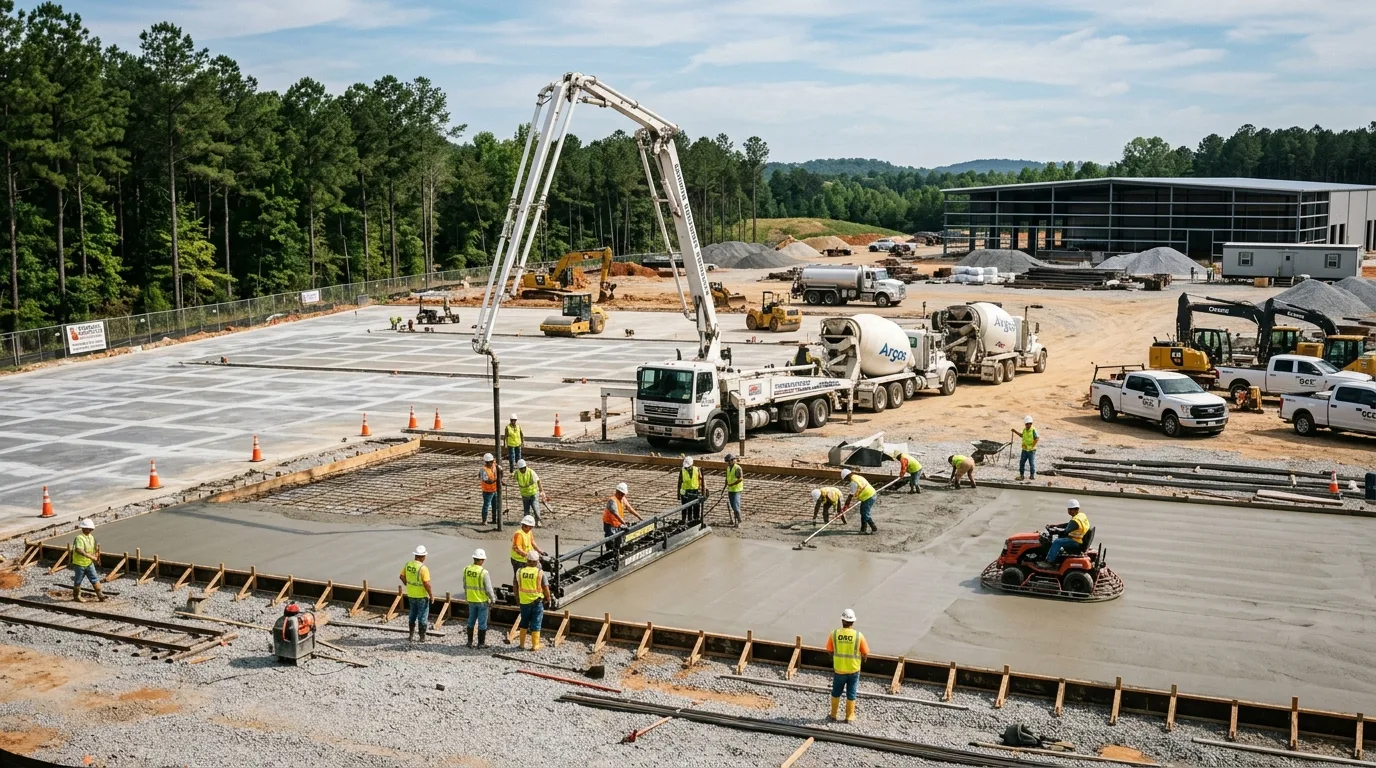
The garage floor is one of the most-used and most-neglected concrete surfaces in a Suwanee home. It absorbs vehicle tire loads daily, oil and chemical spills regularly, and temperature cycling from Georgia’s cold winter nights to summer afternoons. Most homeowners don’t think about the garage floor until it starts showing significant pitting, oil absorption, or surface deterioration — by which point the options have narrowed. This guide covers the full range of concrete garage floor options available to Suwanee homeowners, from new pours to surface upgrades, with honest cost and performance context.
In this post, we cover: new garage concrete slab specifications for Suwanee, surface finish options, resurfacing and coating systems, cost ranges, and the maintenance approach that keeps garage concrete looking good for decades.
Garage Floor Concrete Estimate in Suwanee — Free
From new slabs to resurfacing overlays — we handle all concrete garage floor work. Call (888) 376-0955.
Why Garage Floor Concrete Is Different in Suwanee
Garage floors in Suwanee face a specific set of challenges that combine Georgia’s climate with how garages are used. Vehicle tire contact with hot concrete in Georgia’s summer can cause plain concrete to pick up tire marks that are difficult to remove without sealing. Temperature variation in an unheated garage — from 80°F summer days to 32°F winter nights — creates thermal cycling stress that affects coatings and sealers differently than exterior concrete surfaces.
The Gwinnett County clay soil beneath garages creates the same subgrade movement risks as under driveways and patios. Garage slabs poured without adequate stone base depth show cracking patterns similar to driveways — edge cracking and interior cracks following clay movement directions. The difference is that garage floor cracks are less visible than driveway cracks and often aren’t addressed until they’re quite wide, by which point resurfacing rather than simple crack filling may be needed.
The homeowners in Suwanee’s growing technology corridor neighborhoods — including properties near George Pierce Park and throughout the Laurel Springs area — increasingly use garages as workshops, home gyms, or multi-purpose spaces, which raises the performance requirements for the floor surface.
New Garage Concrete Slab Specifications
For new garage construction or full garage slab replacement in Suwanee, the specifications that matter:
Thickness: Minimum 4 inches for residential garage slabs. For garages that will see occasional heavy vehicles (pickup trucks, trailers) or workshop equipment, 5–6 inches is recommended. Gwinnett County’s clay soil creates enough movement stress that a minimum 4-inch specification is important — thinner slabs are more susceptible to cracking under load combined with clay movement.
Stone base: 2–4 inches of compacted crushed stone beneath the slab is standard for new construction in Gwinnett County. This is especially important for garages, which often have their grade higher than the surrounding area, making drainage management around the slab edges critical.
Concrete mix: 3,500–4,000 PSI is appropriate for residential garage slabs. Fiber reinforcement is the standard for residential garages; rebar is specified for heavier use applications. Air entrainment should be specified for garages where winter temperatures are a concern.
Vapor barrier: A 6-mil polyethylene vapor barrier beneath the slab prevents moisture vapor transmission from the clay soil beneath, which can affect coatings applied to the surface later. This is especially relevant if the garage will be used as a workshop or finished space.
New Garage Slab or Resurfacing in Suwanee?
We pour new slabs and resurface existing garage floors throughout Gwinnett County. Free estimates — (888) 376-0955.
Types of Garage Floor Finish Options
Plain broom finish (new slabs): The standard finish for most Suwanee residential garage slabs. Provides adequate traction, is cost-effective, and can be upgraded later with a sealer or coating. The most practical choice for a basic functional garage.
Concrete sealer: The minimum maintenance upgrade for any bare garage concrete. A penetrating silane/siloxane sealer or film-forming acrylic sealer prevents oil absorption, reduces dusting, and protects against moisture infiltration. Costs $0.25–$0.50 per square foot to apply. This should be done on every new garage slab before the garage is put into use — preventing oil stains is much easier than removing them.
Epoxy floor coating: A two-component epoxy system that bonds to concrete and creates a high-performance, easy-clean surface. Available in solid colors and decorative flake systems (the “chips” that create the distinctive speckled appearance popular in Suwanee garages). Costs $2–$5 per square foot for professional installation. Performance note: epoxy requires thorough surface preparation (acid etching or diamond grinding) and a dry, clean substrate. In Georgia’s humid climate, moisture vapor transmission from clay soil beneath untreated concrete can cause epoxy to peel if a vapor barrier was not installed under the slab. The vapor barrier specification at pour time matters for epoxy longevity.
Polyurea/polyaspartic coatings: A newer coating technology that outperforms epoxy in several ways relevant to Suwanee: better UV resistance (important for garage doors facing south or west), faster cure time (usable within 24 hours), and better flexibility for Georgia’s temperature cycling. Costs $3–$7 per square foot. Increasingly the preferred professional option over standard epoxy in hot climate markets.
Polished concrete: For workshop spaces, home gyms, and high-end garage conversions, mechanically polished concrete creates a durable, low-maintenance surface with a refined appearance. The polishing process gradually refines the surface using progressively finer diamond abrasives. Polished concrete is dense, low-dusting, and highly durable. Less common in standard residential garages but appropriate for high-use or multi-purpose garage spaces.
Resurfacing Options for Existing Garage Slabs
Many Suwanee garages have existing concrete that is structurally sound but cosmetically deteriorated — surface pitting, oil staining, or minor cracking. Resurfacing options:
Micro-overlay resurfacing: A thin (1/16–1/8 inch) polymer-modified cement overlay that restores surface appearance without full replacement. Fills surface imperfections, accepts color and texture finishes, and bonds to clean, sound concrete. Cost: $2–$4 per square foot. Not appropriate for cracked concrete where cracks are still moving — the overlay will re-crack at the same locations.
Self-leveling overlay: A flowing, self-leveling overlay that corrects minor surface irregularities and creates a flat, level surface. Works well for garage floors that have surface pitting or roughness from wear. More expensive than standard micro-overlays but produces a very smooth substrate for subsequent coating application.
Full replacement: When garage concrete has widespread structural cracking, significant settlement from clay movement, or has deteriorated to the point where surface treatments won’t provide lasting results, full slab replacement is the appropriate approach. Cost: $5.65 per square foot (Georgia average for reinforced slab). For a typical 2-car garage (440–600 sq ft), full replacement typically runs $2,485–$3,390 for the concrete work.
Frequently Asked Questions
How much does a garage floor coating cost in Suwanee?
Professional epoxy garage floor coatings in Suwanee cost $2–$5 per square foot installed. Polyurea/polyaspartic coatings run $3–$7 per square foot. A 2-car garage (440 sq ft) runs approximately $880–$3,080 depending on coating type. DIY epoxy kits are available but frequently underperform professional systems due to inadequate surface preparation.
Does Suwanee’s clay soil cause problems for garage floor coatings?
Only if the original slab was poured without a vapor barrier. Moisture vapor transmitting up through the slab from the clay soil below can cause coatings to delaminate over time — particularly epoxy systems, which are more moisture-sensitive than polyurea. A proper vapor barrier under the slab at pour time eliminates this risk. For existing slabs without vapor barriers, a moisture vapor test before coating application is recommended.
When is the best time to coat a garage floor in Suwanee?
Spring (April–May) and fall (September–October) are ideal. Coating systems require surface and ambient temperatures above 50°F and concrete that has equilibrated to ambient humidity. Georgia’s summer humidity can complicate surface moisture readings during coating application. Temperature-controlled curing is possible year-round for enclosed garages with climate control.
Garage Concrete Floors in Suwanee — New Slabs & Resurfacing
We pour new slabs, apply professional coatings, and resurface existing garage floors throughout Gwinnett County. Call (888) 376-0955.
Related: